Skip to content

Speed Reading for Kids 9⁠–⁠12: Read Faster and Understand Schoolbooks

By 9⁠–⁠12 most children read fluently, but the amount of text grows fast: textbooks, chapters, word problems with long instructions. Here is what reading speed is typical at this age, what to train, and how to practise at home for 15⁠–⁠20 minutes 3⁠–⁠5 times a week.

Get the lessonA lesson for your age with a speed test + bonuses: Kelly's brain trainer for 70 days and Schulte tables (number, colour, Gorbov-Schulte). All free, by email.
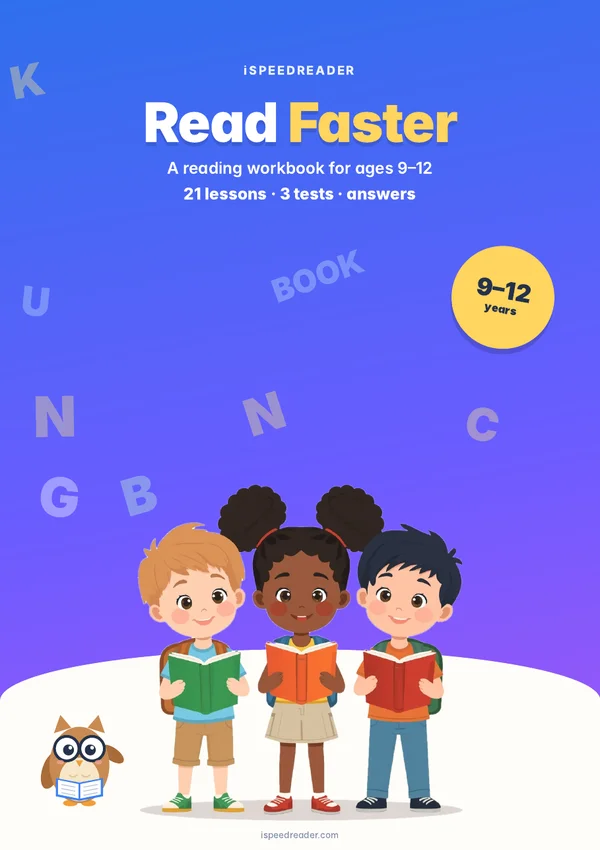
Speed reading course · Ages 9⁠–⁠12PDF workbook · 336 pages · 21 lessons
$19$29−34%
Buy the course — $19

By 9 or 10 most children read whole words with ease. It looks as if reading is sorted, yet this is exactly the age when parents write to us most: "He reads fine but can't retell it", "She spends an hour on one chapter", "He gets word problems wrong because he doesn't finish reading them." Speed reading for kids aged 9⁠–⁠12 is not about records. It is about reading at a steady pace, understanding the text the first time, and handling schoolwork without wasted hours.

Key takeaways
  • At 9⁠–⁠12 the main goal is moving from fluent reading to fast understanding: main idea, questions, retelling.
  • Typical oral reading fluency in the US is about 133 words per minute by spring of grade 4 and about 146 in grades 5⁠–⁠6 (50th percentile, Hasbrouck and Tindal, 2017).
  • Attention exercises, reading in meaningful chunks and timed repeated reading work best.
  • The best rhythm is 15⁠–⁠20 minutes 3⁠–⁠5 times a week. At this age a child can work independently while an adult checks the answers.
  • You can start with a free trial lesson.

Why reading becomes a bottleneck at 9⁠–⁠12

In the early grades texts are short and the teacher explains a lot out loud. In middle school everything changes: new subjects, a textbook for each, longer chapters and more terms. A child who read "just fine" in grade 3 suddenly needs twice as long for homework.

Usually the problem is not speed itself but three habits:

  • Reading word by word. The child says every word to themselves separately and never sees the phrase as a whole. The pace is even but slow, and by the end of the paragraph the beginning is forgotten.
  • Going back. The eyes keep jumping back: "What did it say?" Every regression costs time and breaks the meaning.
  • No strategy. The child reads a textbook like a story, from the first word to the last, without knowing what to look for. Afterwards all that is left is "something about volcanoes".
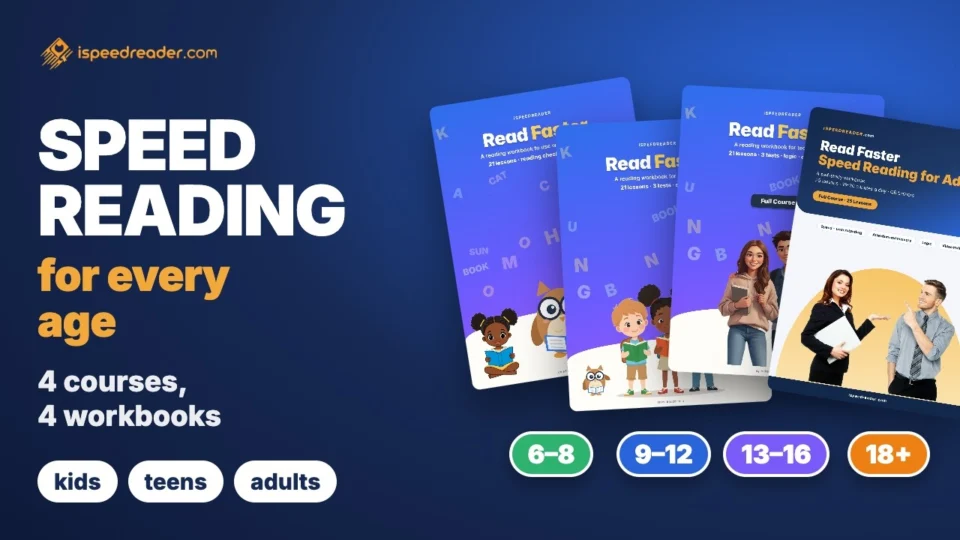
Speed reading for kids 9⁠–⁠12: workbook overviewYouTube

Video: Our four speed reading workbooks for every age: kids, teens and adults. · youtu.be/Yl_jtud2skI · @ispeedreader_en

The good news: at 9⁠–⁠12 the brain learns quickly. Attention and comprehension skills improve faster than in adults, and the child sees the result at school right away. That makes this a great age for structured speed reading practice.

How many words per minute should a child read at 9⁠–⁠12?

Parents often search for "reading speed for a 10 year old" or "how many words per minute should a 5th grader read". There is no single official standard, but in the US teachers widely use the oral reading fluency (ORF) norms by Hasbrouck and Tindal (2017). They count words read aloud correctly in one minute. Here is the 50th percentile:

Grade (age)FallWinterSpring
Grade 3 (8⁠–⁠9)8397112
Grade 4 (9⁠–⁠10)94120133
Grade 5 (10⁠–⁠11)121133146
Grade 6 (11⁠–⁠12)132146146

Notice that growth slows down in grade 6. That is expected: by 11⁠–⁠12, reading aloud approaches the speed of normal speech, and further gains come from silent reading and better comprehension. For comparison, adults read aloud at about 184 words per minute on average across 17 languages (the IReST study, Trauzettel-Klosinski and Dietz, 2012) and read silently faster still.

What should you do with these numbers? Check your child once, write down the result, and from then on compare them only with themselves. If speed grows and the answers to questions are correct, everything is on track.

Speed reading for children aged 9–12
Speed reading for kids 9⁠–⁠12

Another common question is how many pages a 5th grader should read. There is no such norm. A practical guide: 15⁠–⁠20 minutes of relaxed book reading a day on top of schoolbooks. The book should interest your child, or those minutes turn into a chore.

From fluency to comprehension: what we train at 9⁠–⁠12

At 6⁠–⁠8 we taught children to blend sounds and read whole words. At 9⁠–⁠12 the task is different: to see meaning faster than they used to see words.

  • Attention. Holding focus for 10⁠–⁠15 minutes, finding things on the page quickly, switching between tasks. Without it any reading technique falls apart.
  • Reading in chunks. The child learns to see groups of words that belong together, not separate words. Reading becomes smoother and the text easier to understand.
  • Monitoring meaning. A good reader notices when something does not make sense and goes back on purpose, not out of habit.
  • Vocabulary. The more words a child knows, the less they stumble. Anagrams and word searches train recognising words by their letters.
  • Comprehension and retelling. Main idea, questions about the text, retelling with a plan. This is what every school subject needs later.

Speed here is not the goal but a result. When a child sees the whole phrase and does not go back, they read faster without any "pushing".

For a quick start, try our online reading speed test with an age choice: the child reads a text, presses Stop and answers questions. You see both speed and comprehension.
Free speed reading lessonA lesson for your age with a speed test + bonuses: Kelly's brain trainer for 70 days and Schulte tables (number, colour, Gorbov-Schulte). All free, by email.
Get the lesson
This course

Speed reading course · Ages 9⁠–⁠12

Each course is done in a workbook. PDF right after payment: download it on the site or send it to yourself by email, Telegram or WhatsApp.

Ages 9⁠–⁠12Course
Speed reading course · Ages 9–12

Speed reading course · Ages 9⁠–⁠12

PDF workbook

  • PDF · 336 pages
  • 21 lessons · 210 tasks
  • 3 speed tests
  • Texts with questions
  • Answer key
  • Certificate and progress log

For parents

  • 15⁠–⁠20 minute sessions, 3⁠–⁠5 times a week — easy to fit into the day
  • Answers to every task: check your child with no preparation
  • Print only the pages you need — no apps, no screens
  • Speed tests and a progress log show how far your child has come
$19$29−34%
Buy the course

Speed reading exercises for kids 9⁠–⁠12

All these exercises are in our 9⁠–⁠12 workbook. Each task has a short "Why this?" note, so the child knows what they are training and works with purpose.

  • Schulte table 4×4. Find and point to the numbers 1 to 16 in order, and time it. Do the second table faster. Trains attention and quick searching. We compare time only with the child's own previous result.
  • Hide and seek. Eight words on one theme, such as "African animals", are hidden in a letter grid, reading left to right and top to bottom. Trains attention and word recognition.
  • Reading in chunks. A text is divided by slashes into groups of words that are read together, with a short pause at each slash. Then two questions about the text. Reading becomes smoother and understanding easier.
  • Spot the nonsense. A set of sentences, some with an error in meaning ("The sun rises in the west"). Mark which ones are right and correct the wrong ones. Teaches monitoring meaning.
  • Stroop game. Colour words are printed in a different colour. Say the colour, not the word. Trains the ability to stop an automatic habit and focus.
  • Anagrams. The letters are mixed up; make the word, with a picture as a hint. Trains attention to spelling and vocabulary.
  • Gorbov table. Find numbers in turn: black 1, red 1, black 2, red 2… Trains switching attention between two tasks.
  • Letter cancellation. Scan rows of letters, crossing out one letter and circling another. Time it and count. Trains attention and accuracy.
  • Questions and retelling. Answer questions about a text and retell it with a plan: beginning, main event, ending, my opinion.
  • Speed training. The iSpeedReader signature exercise, explained below.

How speed training works. The child reads the same text several times: 3 minutes and a mark, 3 minutes again to get further, then they reach the second mark in 2 minutes and finally in 1 minute. Next they read a new text for exactly one minute and count the words. At the end come questions about the text. The goal is not a record at any cost but steady growth with good understanding: if fewer than 3 out of 4 answers are right, next time we read a little slower. Repeated reading is one of the best-studied methods for building fluency.

A made-up example. Week 1: 105 words in a minute, 4 out of 4 answers. Week 3: 118 words, 3 out of 4. That is a good result: speed is growing and comprehension holds. If answers dropped to 2 out of 4, we would go back to the earlier pace.

How to read a textbook: questions before reading

The most useful skill for middle school is reading a textbook with a purpose. Here is a simple routine a child can learn in a week:

  1. Preview. Read the chapter title, subheadings, bold words and picture captions. It takes a minute.
  2. Ask. Turn headings into questions: "How does a volcano work?" becomes "What is it made of? Why does it erupt?" Look at the questions at the end of the chapter.
  3. Read. Read with a pencil and look for answers to your questions. Read in chunks and do not go back without a reason.
  4. Answer. Close the book and answer the questions out loud. Where you cannot, go back to the right paragraph.
  5. Retell. Briefly retell the chapter using a 3⁠–⁠4 point plan.

This routine saves time because the child reads once carefully instead of skimming three times. Our workbook has tasks that prepare for it: finding the main idea, questions about the text and retelling with a plan.

A 4-week home plan

At 9⁠–⁠12 the best rhythm is 15⁠–⁠20 minutes 3⁠–⁠5 times a week. A full lesson takes 25⁠–⁠35 minutes, so it is easy to split it over two days. The child can work alone, and an adult checks the answers with the key at the back of the workbook and notes progress in the log.

Training plan
  • Week 1: a speed and comprehension check, 4×4 Schulte tables, hide and seek, reading in chunks, speed training.
  • Week 2: add spot the nonsense, the Stroop game, questions and retelling with a plan.
  • Week 3: Gorbov table, letter cancellation, anagrams; "questions before reading" on one textbook chapter.
  • Week 4: a new check on a new text, comparing speed and comprehension with week 1.

How to build one session:

  1. 5 minutes: attention warm-up with a Schulte, Gorbov or Stroop table.
  2. 5⁠–⁠7 minutes: words with hide and seek or anagrams.
  3. 8⁠–⁠10 minutes: reading a text in chunks, then questions.
  4. 7⁠–⁠10 minutes: speed training.
  5. 2⁠–⁠3 minutes: writing the result in the progress log.

Why not an hour every day? Skills settle in the breaks between sessions, and long sessions tire a child before results appear. Three to five sessions a week is a rhythm a child can keep up for the whole school year.

How the 9⁠–⁠12 workbook works

The workbook is a PDF you receive right after payment. Open it on a tablet or print one lesson at a time.

What is inside:

  • 21 lessons with 10 tasks each;
  • age-appropriate fiction and non-fiction texts with questions;
  • three speed tests: Start, Middle and Finish;
  • a "Why this?" note on every task;
  • answers to all tasks at the back;
  • a progress log, a records table and a certificate.
Speed reading lessons for children from age 9
Speed reading lessons for kids from 9

Every lesson follows the same order: attention, words, reading, comprehension, speed training. Children get used to the structure quickly and can work on their own. An adult only needs to check answers and look at the log once a week.

Speed reading courses for other ages

Ages 6⁠–⁠8Course
Speed reading course · Ages 6–8
  • PDF · 339 pages
  • 21 lessons · 210 tasks
  • 3 speed tests
  • Stories and word games
  • Answer key
  • Certificate and progress log
$19$29−34%
Buy the course
Ages 13⁠–⁠16Course
Speed reading course · Ages 13–16
  • PDF · 370 pages
  • 21 lessons · 210 tasks
  • 3 speed tests
  • IQ-style logic
  • Answer key
  • Certificate and log
$24$34−29%
Buy the course
AdultsCourse
Speed reading course · Adults
  • PDF · 692 pages
  • 25 lessons · 330+ tasks
  • 3 speed tests
  • Video trainer in every lesson
  • Online Schulte trainer
  • Certificate with your test results
$29$49−41%
Buy the course
Free test

Find your personality type

80 questions, 10 minutes. See how you learn and remember best: short bursts or long reads, a clear system or a game.

Take the test
AnalystsDiplomatsSentinelsExplorers

Speed reading classes for kids 9⁠–⁠12: what to choose

TutorOnline classWorkbook at home
ScheduleFixedFixedWhenever suits you
CostHigherMediumLower
IndependenceLed by the tutorLed by a teacher on videoThe child works alone, an adult checks
How often1⁠–⁠2 times a week1⁠–⁠2 times a week3⁠–⁠5 times a week, 15⁠–⁠20 minutes
Best forFamilies who want outside structureA teacher without travelChildren ready to follow a plan

Speed reading classes for kids with a teacher give live feedback, but the skill still needs practice between sessions. A workbook gives regular practice with a ready plan. Many families combine both: a tutor or class plus 2⁠–⁠3 workbook sessions at home each week.

An online speed reading trainer is great for warm-ups: a Schulte table or a Stroop test on screen takes 2⁠–⁠3 minutes. Longer texts are better on paper or a tablet: the eyes tire less and it is easier to work with a pencil.

Motivation: how not to turn practice into punishment

At 9⁠–⁠12 children can tell when they are being "made" to do something. Here is what keeps them interested:

  • Competing with yourself. The records table shows growth from lesson to lesson. The child competes only with their own past result.
  • A clear purpose. Explain why: "You'll finish homework faster and have more time for your own things."
  • Choice. Let the child decide which task to start with or which book to read in the evening.
  • Short sessions. Better to stop while it is still fun than to push on until tears.
  • Praise for understanding. Praise correct answers and a good retelling, not just the number.

Common mistakes and when to see a specialist

  • Chasing speed. If correct answers drop, the speed gain is empty.
  • Comparing with classmates. Everyone has their own pace; what matters is your child's progress.
  • Irregular practice. Two weeks every day and then a month off works worse than three times a week, every week.
  • Only schoolbooks. Reading for fun matters as much as training.

See a specialist if at 9⁠–⁠12 your child still confuses letters, mixes up the order of sounds, gets very tired from reading, complains of headaches, or reads much slower than peers with no progress. A reading specialist, educational psychologist or speech-language therapist can help find the cause, and an eye doctor can check vision. Our exercises can be used alongside their recommendations with an agreed workload.

Free trial lesson

Try the format for free. The free lesson starts with a short reading speed check and gives tasks in the style of the workbook: a 4×4 Schulte table, reading in chunks, questions and speed training. It arrives by email together with bonuses: Kelly's brain trainer for 70 days and Schulte tables (number, colour, Gorbov-Schulte).

Write down the first result, practise for two to four weeks, and check again on a new text.

FAQ

How many words per minute should a 10 year old read?

There is no single official standard. By the widely used ORF norms (Hasbrouck and Tindal, 2017), an average 4th grader reads about 133 words correct per minute aloud by spring. Compare your child with their own earlier results.

How many words per minute should a 5th grader read?

The 50th percentile for grade 5 is about 121 words per minute aloud in the fall and about 146 in the spring (Hasbrouck and Tindal, 2017). Whether your child understands a chapter on the first reading matters just as much.

How many pages should a 5th grader read a day?

There is no page norm. A practical guide is 15⁠–⁠20 minutes of relaxed book reading a day on top of schoolbooks, with a book your child actually enjoys.

Can a 9⁠–⁠12 year old practise alone?

Yes. The workbook is built for independent work: every task explains why it matters, and answers are at the back. An adult only needs to check answers and look at the progress log.

How long should practice sessions be?

15⁠–⁠20 minutes 3⁠–⁠5 times a week. If your child is tired, cut the session to a warm-up and one text. Consistency matters more than length.

Will speed reading help with school?

Speed reading does not replace studying, but it helps children understand textbooks faster: they learn to find the main idea, ask questions about a text and go back less often. That saves time on homework.

How is the 9⁠–⁠12 workbook different from the 6⁠–⁠8 one?

At 6⁠–⁠8 we train blending sounds and reading whole words. At 9⁠–⁠12 we train reading in chunks, comprehension, monitoring meaning and attention: 4×4 tables, Stroop, Gorbov and letter cancellation. The texts are longer, and speed training takes several minutes.

Is there a free online speed reading trainer for kids?

Yes. The site has free online tools: a Schulte table, a Schulte test, a Stroop test and a reading speed test. They work well as a warm-up before a workbook lesson.

Free lesson + bonuses by emailGet it