
Speed Reading Courses in Almaty: A Self-Paced Course in English for Kids and Adults
Almaty has a fast-growing international community: families working for global companies, banks and NGOs, teachers and students at international schools and English-medium universities, IT specialists who relocated here. Children in these families often read in English at school and in another language at home, and adults read reports and contracts in English every day. At iSpeedReader we make speed reading courses in English for children and adults. Each course comes as a printable workbook, so you practise at home on your own schedule instead of crossing the city in traffic.
Key points
- Four courses by age: 6–8, 9–12, 13–16 and adults, each in its own PDF workbook.
- The goal is faster reading with the same comprehension, measured by three speed tests.
- Most local centres teach in Russian or Kazakh; our course is in English.
- Start with a free trial lesson and a reading speed test sent to your email.
Speed reading without the myths
Speed reading is the skill of reading faster while still understanding the text. It rests on focused attention, fewer regressions (going back over words), a strong vocabulary and regular practice. It is not “photographing pages” or “reading with both hemispheres”. Research is clear that speeding up without training costs comprehension (Rayner et al., 2016), and an average adult reads non-fiction silently at about 238 words per minute (Brysbaert, 2019). A realistic goal is to beat your own starting speed clearly, with the same understanding. Find your starting point with our online reading speed test.
For children at international and bilingual schools
A child who speaks two or three languages rarely reads them all at the same speed. Slow reading in the language of instruction quietly drags down grades in every text-heavy subject. Our children’s courses train the basics that carry across languages: attention, scanning for the main idea, retelling and vocabulary.
- Ages 6–8: stories, word games and short attention tasks; 21 lessons with 10 tasks each and an answer key for parents.
- Ages 9–12: texts with questions, finding the main idea, retelling.
- Ages 13–16: longer texts, IQ-style logic puzzles and concentration for timed exams such as IGCSE, IB or SAT.
Start the 6–8 course once your child reads whole words rather than syllable by syllable.
For adults working in English
The adult course has 25 lessons and more than 330 tasks, a video trainer in every lesson with a pace from 200 to 900 words per minute, and an online Schulte trainer. Three speed tests at the start, middle and end show your real progress, and the certificate records it. One lesson fits into an evening; with 3–5 sessions a week the course takes about 6–8 weeks.
What you train
- Schulte tables and the Gorbov-Schulte trainer: attention and visual search.
- The Stroop test: resisting distractions.
- Wedge tables and the Kelly trainer: taking in groups of words and keeping a steady pace.
- Texts with comprehension questions: checking that speed does not cost understanding.
Local centre or self-paced course?
Almaty has speed reading and memory centres in most districts, but classes are usually in Russian or Kazakh, run on a fixed timetable and require a commute along busy avenues like Al-Farabi. A self-paced workbook course in English avoids all three. If you prefer to meet in person, the iSpeedReader address in Almaty and directions are at the bottom of this page.
How a lesson works
Every lesson follows the same rhythm, which makes it easy to keep going on busy weeks. It opens with a two- or three-minute attention warm-up, such as a Schulte table or a letter search. Then come technique exercises: reading columns of words, following a line at a set pace, spotting words in a block of text. The core of the lesson is a text with questions, so you check comprehension straight after reading. It ends with a short memory or vocabulary task. Children’s lessons are shorter and built as games; adult lessons add a video trainer and longer texts.
For younger children a parent’s role is simple: sit nearby, read the instructions aloud if needed, time the exercises and check answers against the answer key. Teenagers and adults work on their own.
What results to expect
Progress depends on your starting speed, age and how regularly you practise. People who read slowly because of poor focus or the habit of re-reading usually improve the most. Adults who already read a lot gain less in raw speed but notice they get through long documents with less effort. We do not promise a specific number. Instead, the course has three speed tests, and you see your own results change. Many parents also notice that reading stops being a struggle, so children pick up books more willingly.
Five exercises to start today
- Take the reading speed test and write down your score.
- Do three rounds of the Schulte test and note your times.
- Read for five minutes with a pencil under the line, slightly faster than usual, without going back.
- After each chapter or article, write its main idea in one sentence.
- Repeat the speed test once a week at the same time of day.
More ideas are in our articles on speed reading exercises, attention development and memory development.
Reading habits that make the course work
A course gives structure, but habits make results last. Keep a book in a place you see every day. Read for ten minutes before screens in the evening. For children, let them choose what to read: comics, encyclopedias and adventure stories all count. Talk about what you read at dinner. In a city where many people switch between three languages, regular reading in the language you want to strengthen matters more than any single technique.
Choose your course
The PDF opens right after payment; download it or send it to your email, Telegram or WhatsApp. Pay by Visa or Mastercard, Apple Pay or Google Pay through WayForPay, or with USDT.
Speed reading courses for kids and adults
Each course is done in a workbook. PDF right after payment: download it on the site or send it to yourself by email, Telegram or WhatsApp.
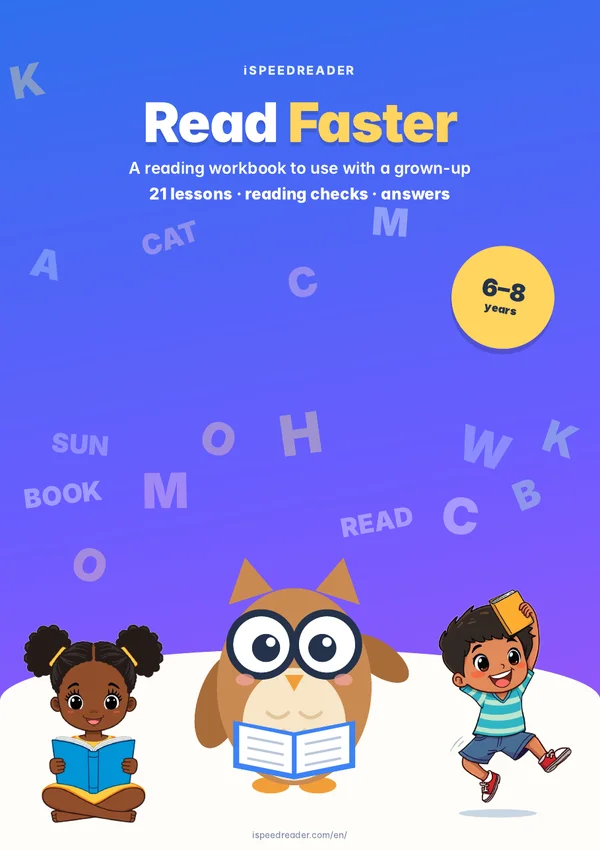
- PDF · 339 pages
- 21 lessons · 210 tasks
- 3 speed tests
- Stories and word games
- Answer key
- Certificate and progress log
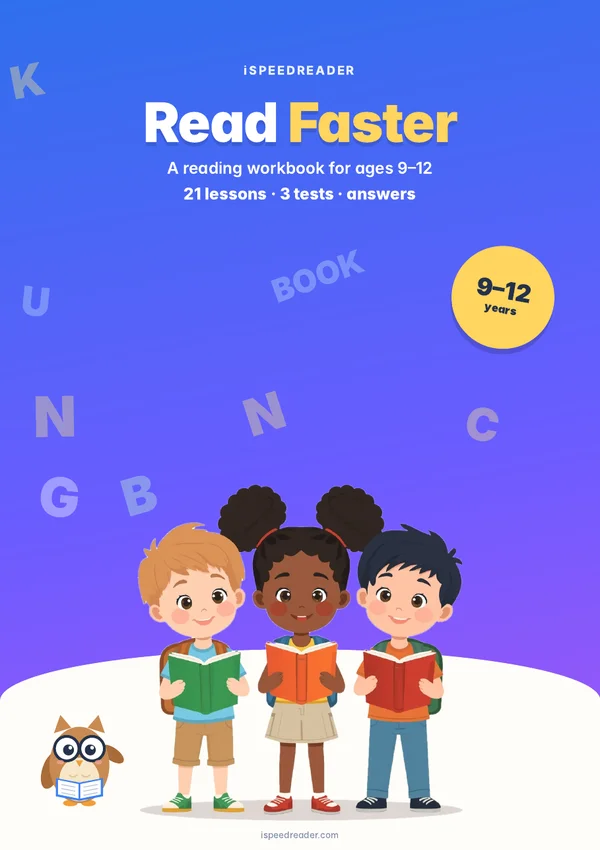
- PDF · 336 pages
- 21 lessons · 210 tasks
- 3 speed tests
- Texts with questions
- Answer key
- Certificate and progress log
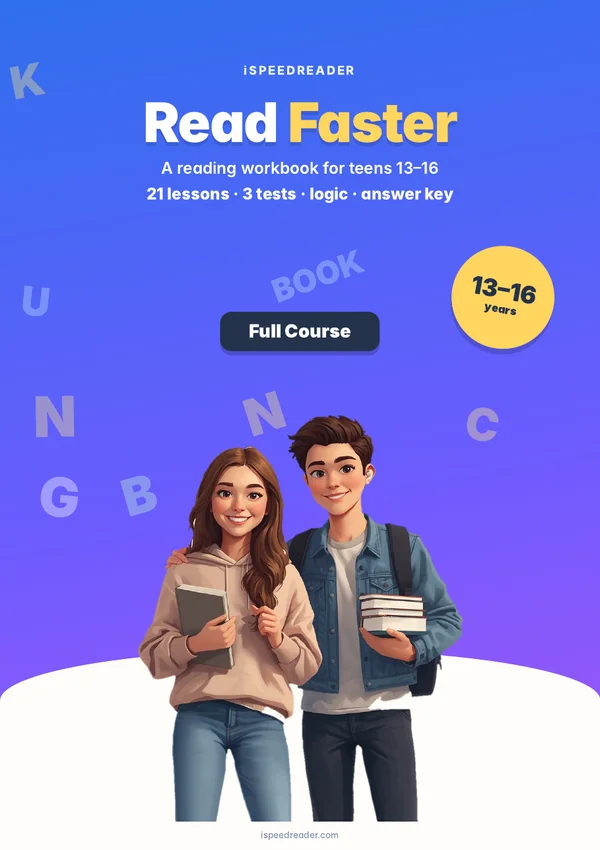
- PDF · 370 pages
- 21 lessons · 210 tasks
- 3 speed tests
- IQ-style logic
- Answer key
- Certificate and log
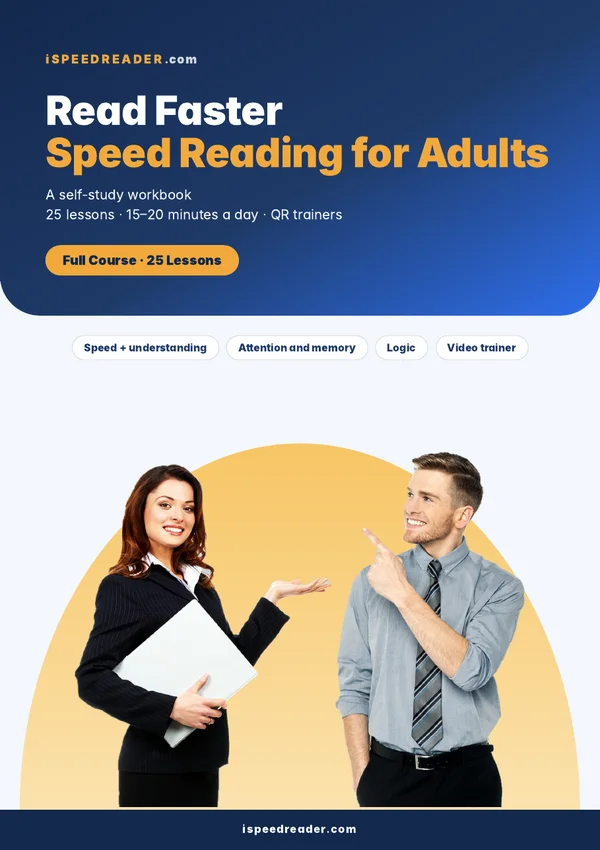
- PDF · 692 pages
- 25 lessons · 330+ tasks
- 3 speed tests
- Video trainer in every lesson
- Online Schulte trainer
- Certificate with your test results
Prices: $19 for ages 6–8 and 9–12, $24 for ages 13–16, $29 for adults, paid once. See the offer agreement and return policy.
FAQ
Can I pay with a Kazakh bank card?
Payments go through WayForPay with Visa, Mastercard, Apple Pay and Google Pay; your bank converts the price into your card’s currency. If a card is declined, you can pay with USDT or email info@ispeedreader.com.
Will it help my child read faster in Russian or Kazakh too?
The lessons are in English, but attention, scanning for the main idea and fewer regressions carry over to other languages. Russian and Ukrainian versions of the course are available on those language pages of the site.
How long does the course take?
Children’s courses have 21 lessons, the adult course 25. With 3–5 sessions a week that is about 5–7 and 6–8 weeks.
Is there a free trial?
Yes. A free trial lesson with exercises, a reading speed test and a video trainer is sent to your email.