
Speed Reading Courses in Bishkek: Learn at Home with a Self-Paced Course in English
Bishkek has a lively English-speaking community. The American University of Central Asia teaches in English, international organisations and NGOs run their offices here, and more families send children to international and English-medium schools. For all of them, reading in English is a daily task, and for many it is a second or third language. At iSpeedReader we build speed reading courses in English for children and adults. Each course is a printable workbook, so you can practise at home, whether you live near Ala-Too Square or in one of the newer microdistricts, without commuting to classes.
The short version
- Speed reading means reading faster with the same understanding, not skimming.
- Most local centres teach in Russian or Kyrgyz; our course is in English.
- Four courses by age, each with speed tests at the start, middle and end.
- Try it free: a trial lesson with a reading speed test is sent to your email.
Signs that a course would help
Parents usually notice the same things before teachers do. Reading homework takes the whole evening. A child finishes a paragraph and cannot say what it was about. Their eyes keep jumping back to the start of the line. Tests run out of time even when the child knows the material. Books stay on the shelf. Adults recognise a different set of signs: rereading emails, putting off long reports, finishing a chapter and remembering nothing.
If two or three of these sound familiar, take our online reading speed test and compare your result with the reading speed norms for your age. A low speed with good comprehension is exactly what a speed reading course addresses. If a child still sounds out syllables or mixes up letters, work on reading aloud first, and see a specialist if you suspect a speech or reading difficulty.
What speed reading is, and is not
Speed reading is not photographing a page or reading “with both hemispheres”. It is a set of trainable skills: steady attention, fewer regressions, quick recognition of familiar words and the habit of grasping the main idea first. Research on reading shows that simply speeding up without training lowers comprehension (Rayner and colleagues, 2016), and that adults read non-fiction silently at about 238 words per minute on average (Brysbaert, 2019). That is why every lesson in our course comes with comprehension questions, and the goal is to clearly beat your own starting result.
Reading in a second language
Almost everyone reads more slowly in a second language. Students at English-medium universities feel it during exam sessions, when dozens of articles have to be read in a few days. Professionals feel it with long reports and contracts. Our course does not replace language learning, but it trains the parts of reading that are not about vocabulary: keeping your eyes on the line, not going back, holding the thread of a paragraph and getting to the main idea quickly. Because the course itself is in English, every lesson is also reading practice in English.
Courses by age
Ages 6–8
The course for kids aged 6–8 feels like a game: stories, word games, letter and number searches. It has 21 lessons with 10 tasks each, an answer key for parents and a certificate at the end. Start once your child reads whole words.
Ages 9–12
The course for ages 9–12 focuses on understanding texts, answering questions and retelling. This is the age when reading often slips, because the amount of text grows fast.
Ages 13–16
The course for teens brings longer texts, IQ-style logic puzzles and concentration training, a solid base before timed exams such as SAT, IELTS or IGCSE.
Adults
The adult course has 25 lessons and more than 330 tasks, a video trainer in every lesson from 200 to 900 words per minute and an online Schulte trainer.
How we train the skill
Each exercise has a clear job. Schulte tables train attention and visual search. The Stroop test trains resistance to distraction. Wedge tables and the Kelly trainer widen the number of words you take in and steady your rhythm. Texts with questions check understanding, and memory tasks help you keep what you read. One lesson fits into an evening, and we recommend 3–5 sessions a week. At that pace children’s courses take about 5–7 weeks and the adult course about 6–8 weeks.
A local centre or a self-paced course?
Bishkek has learning centres across its districts, and some offer speed reading. If you go that way, ask whether there is an entry test, how results are measured and what the whole course costs, and be careful with promises of thousands of words per minute. The main limits of local centres for English speakers are language and logistics: classes are usually in Russian or Kyrgyz, and getting across the city at rush hour takes time. A self-paced workbook course avoids both. If you prefer to meet in person, the iSpeedReader address in Bishkek and directions are at the bottom of this page.
Choose your course
The PDF opens right after payment; download it or send it to your email, Telegram or WhatsApp. Pay by Visa or Mastercard, Apple Pay or Google Pay through WayForPay, or with USDT.
Speed reading courses for kids and adults
Each course is done in a workbook. PDF right after payment: download it on the site or send it to yourself by email, Telegram or WhatsApp.
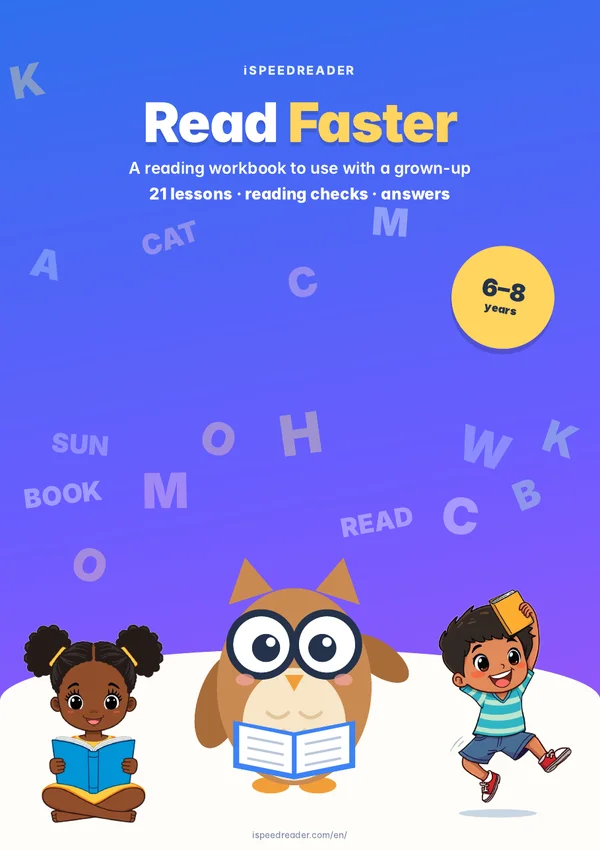
- PDF · 339 pages
- 21 lessons · 210 tasks
- 3 speed tests
- Stories and word games
- Answer key
- Certificate and progress log
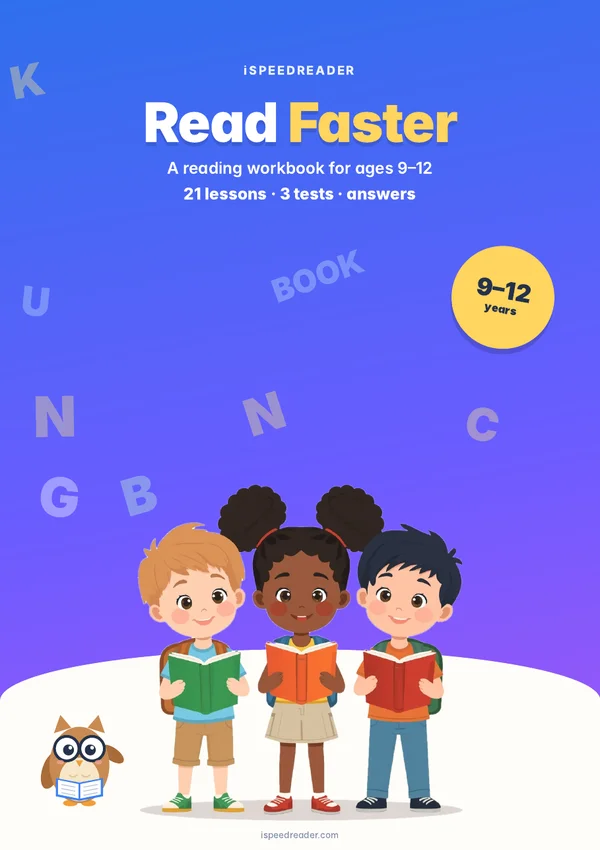
- PDF · 336 pages
- 21 lessons · 210 tasks
- 3 speed tests
- Texts with questions
- Answer key
- Certificate and progress log
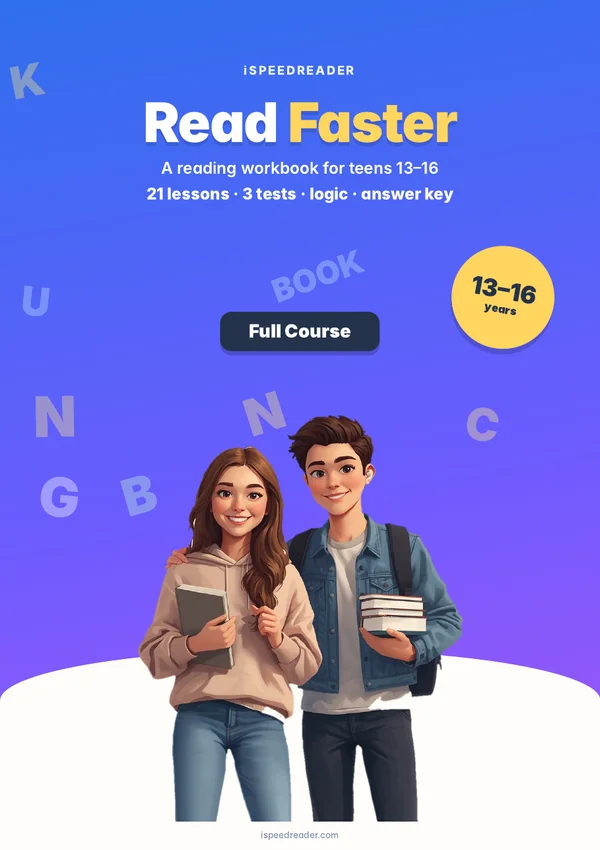
- PDF · 370 pages
- 21 lessons · 210 tasks
- 3 speed tests
- IQ-style logic
- Answer key
- Certificate and log
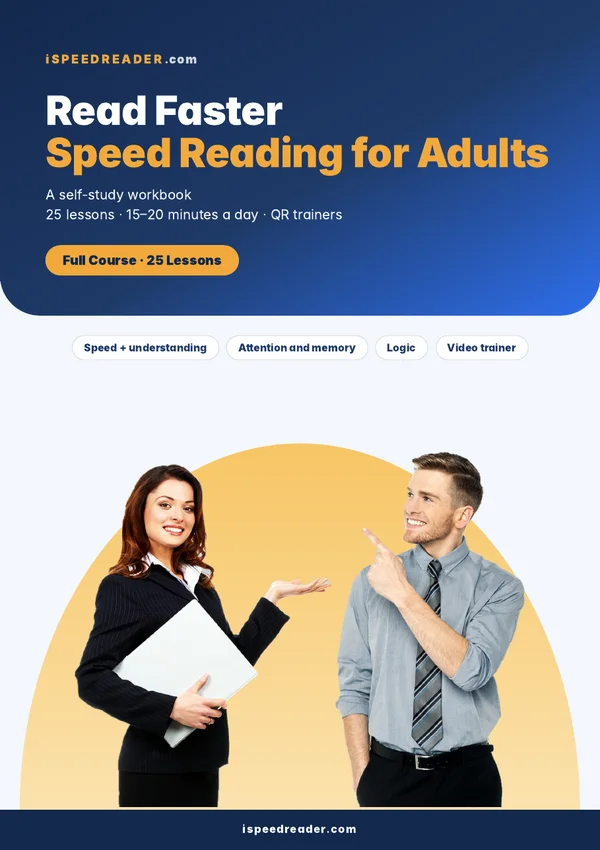
- PDF · 692 pages
- 25 lessons · 330+ tasks
- 3 speed tests
- Video trainer in every lesson
- Online Schulte trainer
- Certificate with your test results
Prices: $19 for ages 6–8 and 9–12, $24 for ages 13–16 and $29 for adults, paid once for the whole course. See the offer agreement and return policy.
How to get results
- Take the speed test before the first lesson and write down the result.
- Pick a fixed time, for example after dinner, 3–5 times a week.
- With younger children, sit nearby: read instructions, time exercises, check answers.
- Do not skip lessons, even when a task looks easy.
- Take the mid-course and final tests at the same time of day as the first one.
For more practice, see our articles on speed reading exercises and attention development.
FAQ
Can I pay with a Kyrgyz bank card?
Payments go through WayForPay with Visa, Mastercard, Apple Pay and Google Pay. If your card is declined, pay with USDT or email info@ispeedreader.com.
Is there a version in Russian?
Yes. Russian and Ukrainian versions of the course are on those language pages of the site. This page offers the English courses.
How long does it take?
Children’s courses have 21 lessons and the adult course 25. With 3–5 sessions a week that is about 5–7 and 6–8 weeks.
Is there a free trial?
Yes. A free trial lesson with exercises, a reading speed test and a video trainer is sent to your email.